User Guide
Stream's mapping flow is built from a few well-defined inputs and a modular pipeline. The pages below explain each piece as it works today.
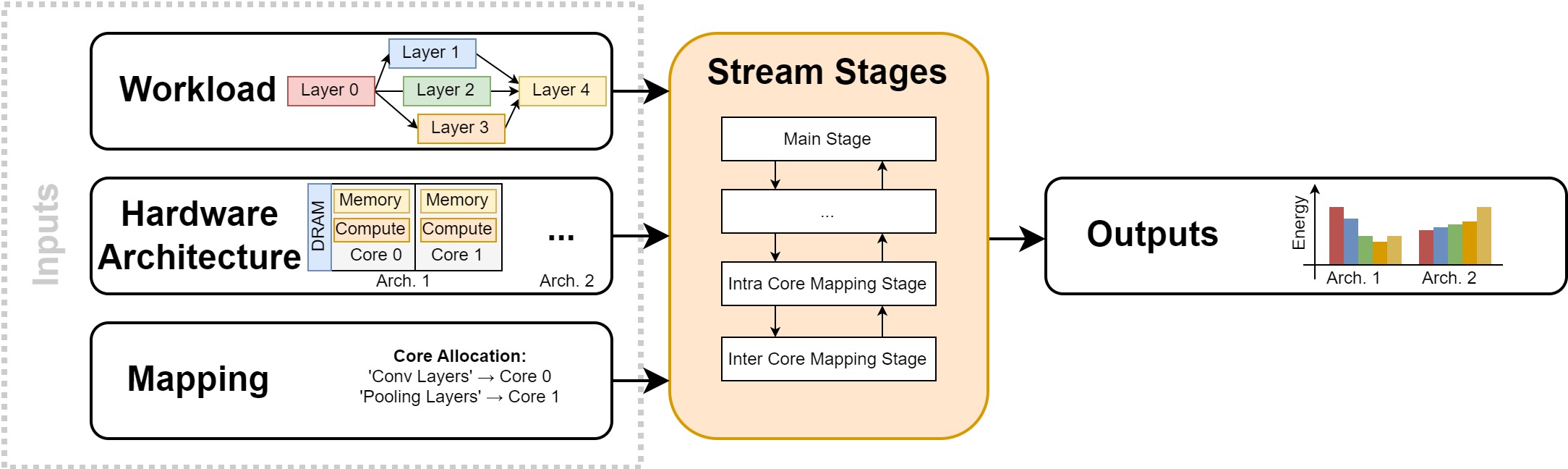
Inputs
- Workload - how Stream reads an ONNX model and turns it into a computation graph (supported operators, shape inference, weight handling).
- Hardware - how an accelerator is described as a system of heterogeneous cores: the accelerator file, core files, memory hierarchy, and interconnect.
- Mapping - how operators are matched to cores and split across them, either auto-generated or hand-written.
Pipeline & outputs
- Stages - the sequence of stages that parse, tile, cost, allocate (MILP), and estimate memory, and how to add your own.
- Outputs - the latency/schedule results, summary files, visualizations, and typed IR.
Driving Stream from an agent
- Using Stream with an AI agent - the MCP server and the IR models for programmatic/structured access.
For design rationale, see the publications page or read the source on GitHub.